
No. 02 (663) January 2026
More Than a History: A New Volume on Central Asia’s Water Heritage Published
The Scientific-Information Center of the Interstate Commission for Water Coordination (SIC ICWC) presents a landmark publication, Water Heritage of Central Asia: Value for Present and Future Generations. This volume treats water as more than just a natural resource; it explores it as the cornerstone of the region’s cultural identity, social structure, and historical evolution.
Comprising thematic and country-based studies, the publication follows a nexus-based perspective, highlighting the interconnections between environmental, technological, social, and cultural dimensions of water use. The authors examine both tangible and intangible forms of water heritage - from water sources, landscapes, and irrigation infrastructure to traditional knowledge, social institutions, rituals, and practices of water governance. In Central Asia’s arid environment, water has shaped patterns of survival, economic growth, and state formation for millennia. The region saw the emergence of distinctive irrigation and sustainable water management and distribution mechanisms, sustained by the institution of mirabs, adat (customary law), and communal labor practices.
5 highlights:
- Ancient High-Tech: provides a detailed account of kyarizes and sardobas—sophisticated underground galleries and reservoirs that extract and store water in arid environments. By relying solely on gravity and a profound understanding of the landscape, these systems operate without electricity or pumps, offering proven, energy-efficient blueprints for the irrigation challenges of the future.
- Mirabs, the “Guardians of water”: Readers are introduced to the institution of the mirab, the traditional water managers. Combining technical expertise with celestial observation, mirabs governed irrigation cycles according to the position of the stars and the fall of shadows. These officials, often marked by formal insignia, were the arbiters of justice whose decisions on fair allocation held legal force.
- The Secrets of Issyk-Kul: One article is devoted to the “Central Asian Atlantis”—submerged settlements and artifacts on the floor of Lake Issyk-Kul, where discoveries range from Saka bronze cauldrons to traces of medieval communities.
- Water as politics: The studies reveal how water landscapes have shaped the region’s political geography for centuries, influencing state boundaries and the routes of the Great Silk Road.
- A social network of the past: The tradition of hashar – collective work, e.g. canal cleaning - is explored not merely as labor, but as a powerful social mechanism that bound communities together.
“Understanding water as a driver of state development requires an exploration of its history. This legacy - comprising technology, social structures, and governance - is what defines the region’s water heritage today”
This publication is designed for a diverse audience, ranging from scholars and policymakers to environmentalists and journalists. It is an essential resource for anyone concerned with the history and future of Central Asia. It invites readers to view water heritage not merely as a legacy of the past, but as a source of practical knowledge that can inform more sustainable development pathways in the years ahead.
This volume is the outcome of research conducted by the Expert Platform on Water Security, Sustainable Development and Future Studies as part of the International Climate Initiative (IKI) project “Regional Mechanisms for a Low-Carbon and Climate-Resilient Transformation of the Energy-Water-Land Nexus in Central Asia.”
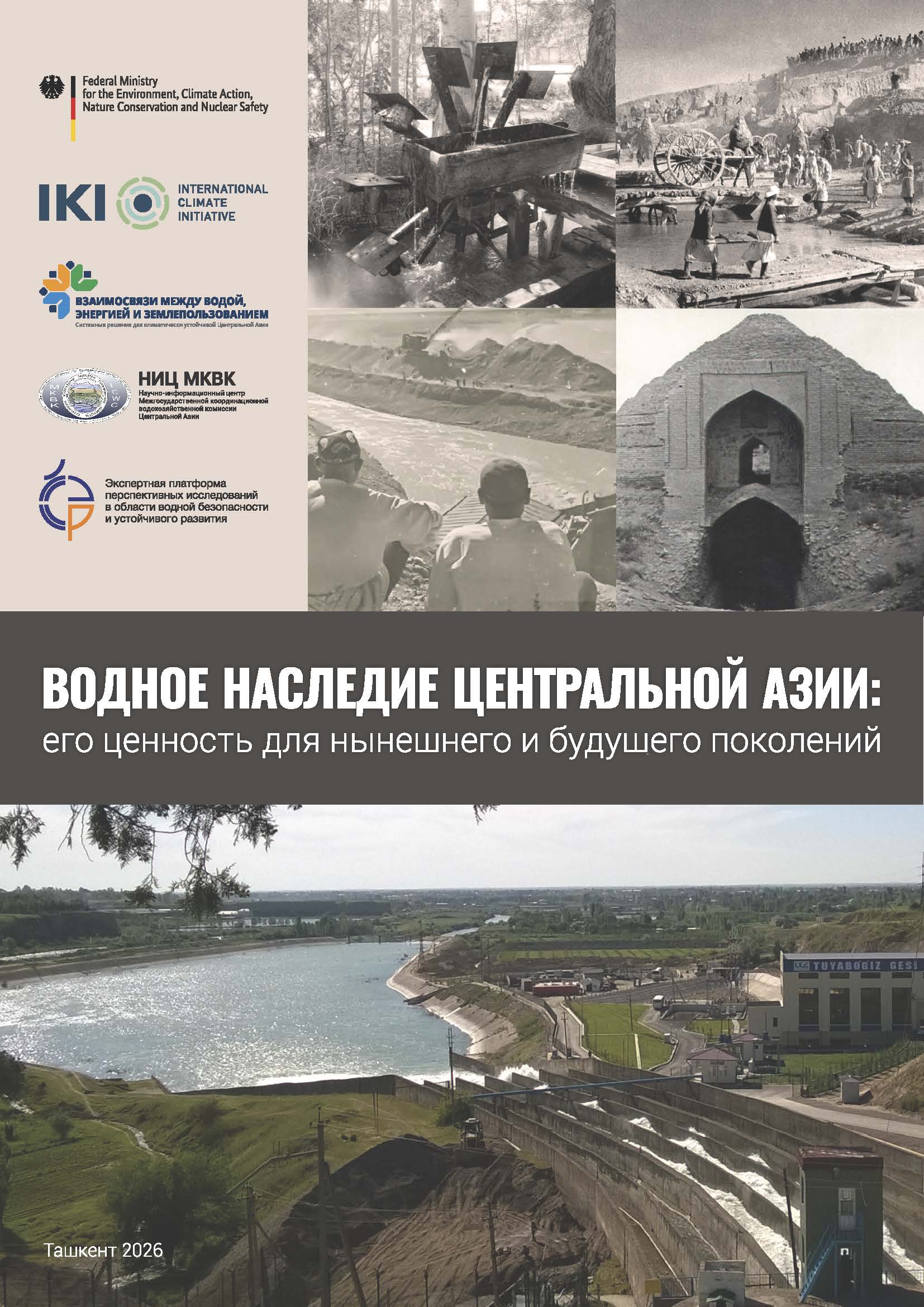
The publication (full version)
Reference on: IKI Project
Reference on: Expert Platform