
No. 28 (689) April 2026
From Adaptive Participant to Co-Author of the Global Agenda: Kazakhstan’s Diplomatic Evolution at the UN General Assembly (2020–2025)
To mark the 80th anniversary of the United Nations, the SIC ICWC has released a new study examining the evolution of Kazakhstan’s foreign policy through its statements at the UN General Assembly. Covering the period from 2020 to 2025, the study builds on earlier research conducted in 2021, which analyzed Kazakhstan’s UN General Assembly statements from 1992 to 2020
The new analysis focuses on a particularly dynamic five-year period during which Kazakhstan’s diplomacy expanded in scope and demonstrated a significant qualitative shift, reflecting the country’s growing role within the global governance system.
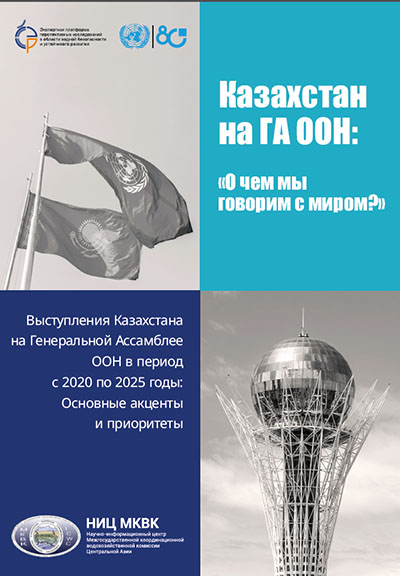
Key Findings:
- 1. From declarations to concrete initiatives Kazakhstan’s diplomatic messaging has evolved from general statements to a more strategically structured foreign policy approach. Recent speeches consistently align with the Sustainable Development Goals, international agreements, and global challenges. They also propose concrete institutional and practical solutions, including initiatives related to UN reform, nuclear disarmament, and biosafety.
- 2. Increased agency on the global stage Kazakhstan has moved beyond the role of a participant in international processes to become an active contributor to the global agenda. The country advances initiatives in peacekeeping, environmental sustainability, digitalization, artificial intelligence, energy, and regional transport infrastructure development.
- 3. A new model of regional leadership Kazakhstan’s UN discourse reframes Central Asia as a region of opportunity rather than challenge. Key priorities include:
- Addressing environmental issues, including the preservation of the Aral Sea and Caspian Sea’s water resources;
- Supporting Afghanistan’s inclusive development through humanitarian assistance, trade, and transport connectivity;
- Strengthening regional supply chains and enhancing Eurasian logistics capacity;
- Promoting dialogue and reconciliation in regional conflicts, including Azerbaijan–Armenia and the Middle East.
“The trends observed in Kazakhstan’s international engagement from 2020 to 2025 reflect the emergence of a new national narrative: a modern, responsible, and strategically oriented state capable of contributing solutions at both regional and global levels,” the study concludes.
Results and Outlook
The study provides a comprehensive overview of the evolution of Kazakhstan’s foreign policy priorities and serves as a valuable resource for diplomats, international relations experts, and analysts assessing the country’s trajectory in a rapidly changing global landscape.
A broader series of studies covering all Central Asian countries is currently in preparation.
The development of a unified regional analytical database will enable:
- Comparative analysis of foreign policy priorities across Central Asian states;
- Identification of shared approaches to environmental challenges, water resource management, and regional security;
- A more integrated understanding of Central Asia’s role in global diplomacy.
More information is available here