
No. 48 (709) June 2026
Forum "Nexus Approach in Central Asian Region – Science – Policy - Practice"
On 25 May 2026, the Institute of Water Problems, Hydropower and Ecology of the National Academy of Sciences of Tajikistan hosted the thematic forum " NEXUS Approach in Central Asian Region: Science-Policy-Practice" in Dushanbe, Tajikistan. The event was organized as part of the 4th High-Level International Conference on the International Decade for Action "Water for Sustainable Development", 2018–2028.
The Forum was organized by the Centre for Sustainable Solutions with Practical Hydrogeology (CSSPH, United Kingdom) in close cooperation with the Agency for Land Reclamation and Irrigation and the Head Department for Geology of the Republic of Tajikistan. The event was co-chaired and coordinated by Shammie Puri, Director of CSSPH; Anatoly Krutov, International Consultant on Integrated Water Resources Management (IWRM); Bakhrom Gaforzoda, Secretary of the National Commission on Irrigation and Drainage of Tajikistan; and Abdumajid Salimov of the Head Department of Geology.
The Forum was moderated by Aminjon Gulakhmadov, Director of the Institute of Water Problems, Hydropower and Ecology.
The plenary session featured keynote presentations by leading international experts, including Sonja Köppel, Secretary of the UNECE Water Convention (Geneva, Switzerland); Akhdiya Kurbonova, Climate Policy Manager for Central Asia at the British Embassy; John Mark Church of UNECE; and other distinguished experts.
In her presentation, Sonja Köppel highlighted the persistent systemic gap between the management of surface water and groundwater. She emphasized that water systems worldwide are under unprecedented pressure:
- nearly 75% of the global population lives in areas experiencing water insecurity, while many river basins are already operating beyond their hydrological limits.
- Climate change is further disrupting the water cycle, leading to more frequent droughts, floods, and extreme weather events. As a result, hydrological conditions are becoming increasingly unstable and difficult to predict.
- Groundwater currently accounts for approximately 50% of domestic water use and more than 40% of irrigation worldwide. However, it is increasingly being relied upon to compensate for declining surface water resources.
- Surface water and groundwater continue to be managed largely in isolation. Fragmented governance, unregulated abstraction, and the limited application of conjunctive management approaches contribute to resource overexploitation, operational inefficiencies, and heightened systemic risks.
- Only a limited number of transboundary water agreements fully incorporate the principle of integrated surface and groundwater management, underscoring the need for urgent changes.
Ms. Köppel also presented the results of the third reporting cycle for SDG 6.5.2 (2023), which measures the proportion of transboundary waters covered by operational cooperation arrangements. Of the 153 UN Member States that share transboundary waters, only 43 have operational agreements covering 90% or more of their shared rivers, lakes, and aquifers, compared to 30 countries in 2020. More than 20 countries still lack any operational agreements on transboundary waters. The greatest progress has been achieved in Europe, North America, and sub-Saharan Africa, while Latin America and Asia require more intensive efforts to strengthen transboundary water cooperation. Monitoring SDG 6.5.2 since 2017 has generated positive outcomes by encouraging follow-up actions, helping countries identify data gaps, and significantly improving the quality and comprehensiveness of national reports by 2023.
During the Forum, G. Khamdamova, expert from SIC ICWC, delivered a presentation “Science in the Service of Water Policy in Central Asia.” The presentation outlined the Center’s key research findings on integrated water resources management in the transboundary Syr Darya and Amu Darya River basins. Particular attention was paid to the role of scientific evidence, analytical tools, and decision-support systems in shaping regional water policy, including issues related to surface–groundwater interactions and climate change adaptation.
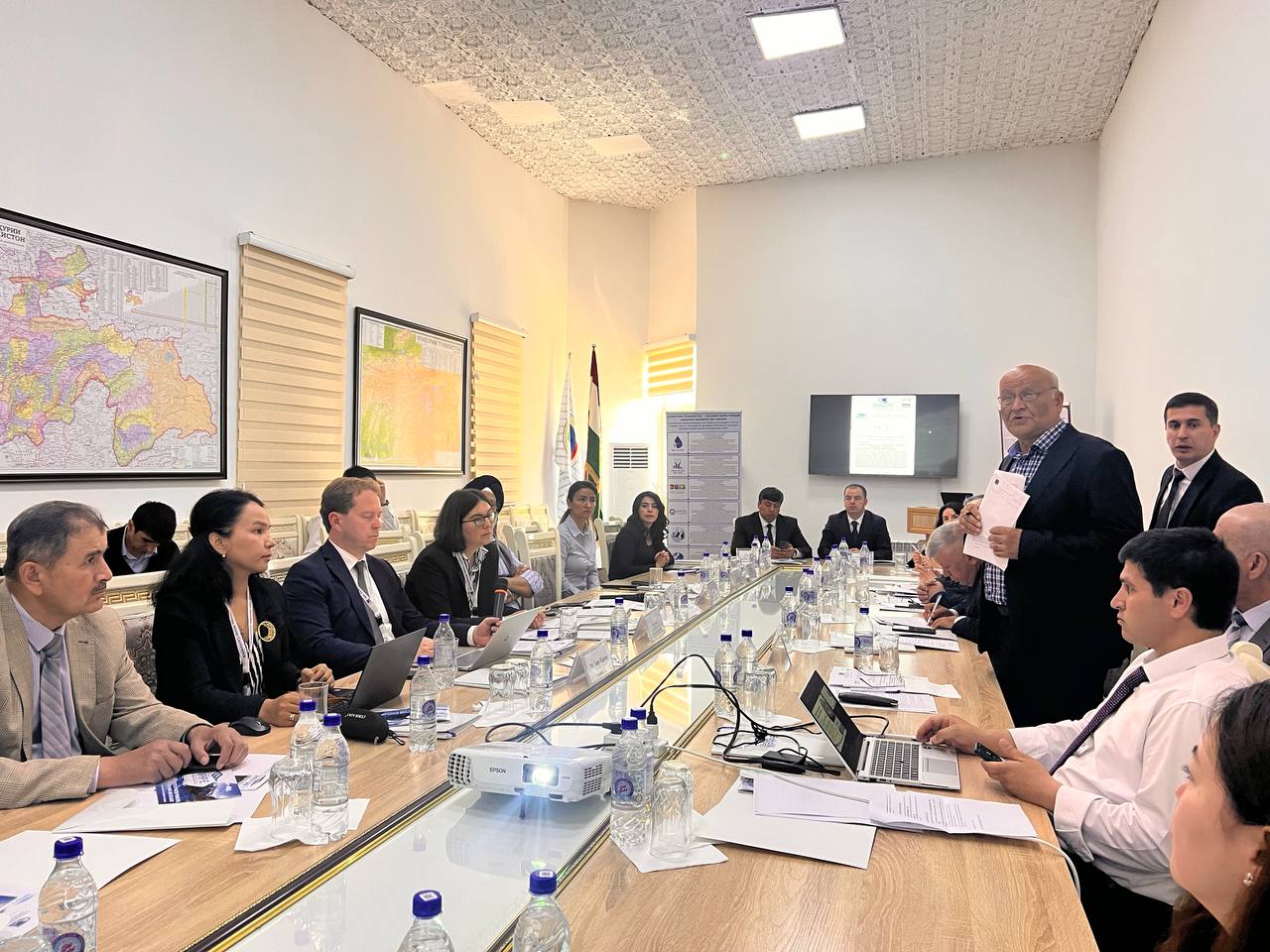
Following the presentations, participants engaged in a panel discussion focused on developing practical recommendations and identifying mechanisms for future action. The discussion revealed broad consensus on several priorities, including the transition from unregulated water use to integrated management of surface water and groundwater, the strengthening of cross-sectoral coordination, and improved transparency and accessibility of data at the transboundary basin level.
The Forum concluded with three key messages:
- Groundwater should be recognized as a strategic, shared, and climate-resilient resource in the Syr Darya and Amu Darya basins;
- Integrated management of surface water and groundwater provides a practical pathway for reducing tensions among irrigation, hydropower generation, and municipal water supply sectors;
- Data transparency, shared modelling platforms, and stronger basin institutions are essential for the cooperative and sustainable management of the region’s water resources.