
No. 70 (731) July 2026
Sixth meeting of the Regional Working Group on a Mutually Beneficial Water-Energy Mechanism
On 16 July 2026, the Sixth Meeting of the Regional Working Group on a Mutually Beneficial Water–Energy Mechanism was held in Bishkek under the Green Central Asia II and the “Regional Mechanisms for a Low-Carbon and Climate-Resilient Transformation of Energy–Water–Land Nexus in Central Asia” (IKI) Project. The meeting brought together representatives of water, energy, economic, and foreign affairs authorities from the Central Asian countries, as well as regional organizations and international development partners.
The meeting focused primarily on the proposals presented by the Kyrgyz Republic for establishing a mutually beneficial water–energy cooperation mechanism. Participants exchanged views on the proposed approaches, discussed the possible guiding principles of the mechanism, and identified priorities for further joint work. Particular emphasis was placed on searching for solutions that balance the interests of all Central Asian countries while addressing contemporary challenges related to climate change, sustainable water management, and regional cooperation.
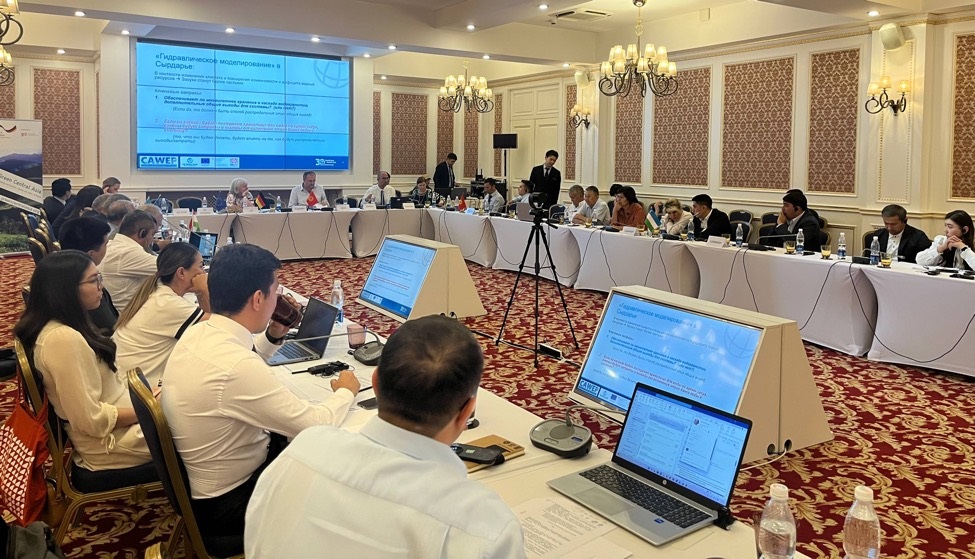
During the thematic session, SIC ICWC delivered a presentation “From models to mutually beneficial mechanisms,” highlighting contemporary scientific tools for supporting water–energy cooperation.
The presentation featured:
- the results of applying the integrated WEAP–LEAP modelling framework to assess water-energy development scenarios for the Amu Darya and Syr Darya river basins, including analyses of the impacts of climate change, hydropower development, and measures to improve water-use;
- the initial results of the HPm-GAMS, CHPm, WAm, and Em-Nexus modelling system currently developed under the IKI project, designed to optimize hydropower operation regimes, assess water and energy scenarios, and analyze the economic benefits of regional cooperation;
- proposals for strengthening financial mechanisms to support water–energy coordination, including approaches to cost and benefit sharing, the enhancement of payment guarantee mechanisms, and the mobilization of long-term financing for joint infrastructure projects.
The presentation generated an active discussion and underscored the growing importance of advanced modelling and analytical tools in supporting decision-making on transboundary water and energy management. Participants emphasized the need to continue collaborative efforts toward developing a scientific evidence based and feasible mutually beneficial mechanism for water–energy cooperation in Central Asia.
Particular interest was expressed in SIC ICWC’s initiative to prepare a Terminology Reference Guide on financial mechanisms of water–energy coordination and interstate water cooperation. Participants noted that the development of a common conceptual framework and harmonized terminology would make an important contribution to strengthening professional dialogue and facilitating practical solutions for regional water–energy cooperation.
More on IKI Nexus Project
More on WB Project “Water-Energy Nexus Systems Modelling”