
No. 82 (743) August 2026
SIC ICWC Experience Presented at Climate Science Dialogue
On 14 August 2026, the Green University in Tashkent hosted the Climate Science Dialogue on “Science, Innovation and Cooperation for a Climate-Resilient Central Asia.”
The discussions focused on science-policy interface, water diplomacy and wetlands in the Aral Sea basin, impacts of climate change on water, agriculture, and energy, as well as innovation, circular economy, and regional cooperation to strengthen climate resilience. The Climate Residency Program and the Central Asian Climate Leadership Program were also presented during the Dialogue.
During the session “Wetlands of the Aral Sea and Water Diplomacy in Central Asia,” Dinara Ziganshina, Director of SIC ICWC, made a presentation on “Advancing Ecosystem and Climate Science in Basin Water Management”.
She focused on a practical challenge: how to translate research findings into concrete solutions for river basin management and into meaningful engagement with local communities. The SIC ICWC experience was presented through several interconnected areas, ranging from the integration of the nexus approach into the work of sectoral ministries to basin-level research and practical climate adaptation measures at the local level.
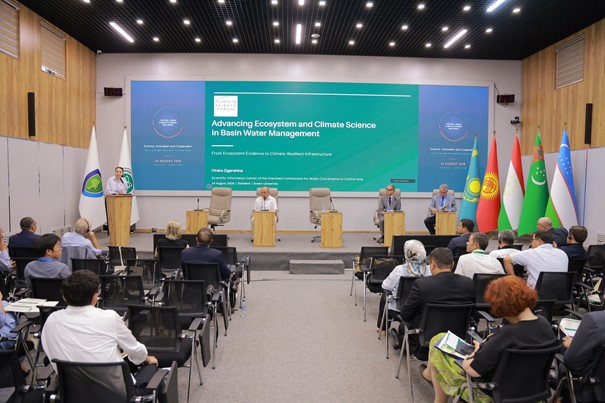
Showcasing the study of ecosystems in the Amu Darya basin, conducted with the support of GIZ, Ms. Ziganshina demonstrated the importance of fully integrating ecosystem considerations into basin management. Priority areas identified included ensuring environmental flows, restoring tugai forests and ecological corridors, developing a unified monitoring system, and closely aligning environmental protection objectives with water management practices.
Particular attention was paid to the study of climate resilience of water infrastructure in the Syr Darya basin. The key idea is that resilience depends on the condition of the entire basin system, including infrastructure, operation regimes, data, regulatory frameworks, and institutions. Such an approach requires that future climate variability shall be taken into account when designing and modernizing infrastructure, operating facilities throughout their entire life cycle, as well as the use of forecasts and monitoring data to adjust operation regimes, and coordination of measures at the basin-wide level..
The conclusion was that climate and ecosystem research gains practical value when its findings are incorporated into basin planning, infrastructure operation, and interstate coordination.
More information about the SIC’s projects presented in the report:
- “Regional Mechanisms for a Low-Carbon and Climate-Resilient Transformation of the Energy, Water and Land Nexus in Central Asia” —project of the International Climate Initiative (IKI), which among other activities, develops “Nexus Profiles” to support the operationalization of the nexus approach by sectoral ministries.
- Studies on Priority Issues in the Field of Water, Energy and Environment in the Amu Darya and Syr Darya Basins with the support of GIZ — studies of ecosystems in the Amu Darya basin and of climate resilience of water infrastructure in the Syr Dyra basin
- Facilitating Region-Specific Approaches to Addressing Climate and Environment-Related Risks for Socio-Economic Stability in Central Asia — work with local communities in the Fergana Valley and development of locally initiated climate adaptation measures.