
No. 84 (745) August 2026
Regional Knowledge Should Become Part of Global Water Solutions
On 24 August 2026, the session “Evidence for Action: the UN Water Conference Academic Hub” was held as part of World Water Week in Stockholm. The session brought together representatives of universities, research institutions, the UN system, government bodies, expert communities and youth networks to discuss how to ensure that scientific knowledge is effectively used in water-related decision-making.
The session focused on the contribution of the Academic Hub to preparations for the 2026 UN Water Conference. Participants discussed ways to translate research findings into concise and accessible materials for decision-makers and to engage researchers from the Global South, young professionals and experts from different disciplines in shaping the global water agenda.
Speaking at the session on behalf of the Central Asian regional branch of the Women in Water Diplomacy Network, Oygul Usmanova, Head of the International Communications Division at SIC ICWC, emphasized that the science-policy interface should work in both directions. It is important not only to bring global scientific knowledge to countries and regions, but also to create channels through which regional data, practical experience and solutions can reach the global level and inform decision-making.
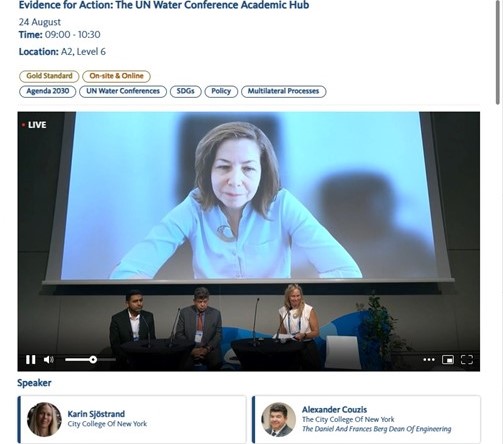
As an example, the work of the regional Network on two policy briefs was presented — one on inclusive water governance and the other on data sharing as a tool for building trust and strengthening resilient water management in Central Asia. The work was initiated by the United Nations University in Dushanbe. Notably, the briefs are being prepared by experts from the region, particularly young professionals. Their task is not only to synthesize existing research, but also to translate regional data and experience into clear policy messages and actionable recommendations for presentation at the upcoming UN Water Conference. Particular attention was paid to data sharing. For Central Asia, the issue is not only whether sufficient information is available, but also whether it can be shared, trusted and used as a common basis for dialogue and decision-making. Data sharing therefore goes beyond its technical function: it can help build trust among countries and contribute to more resilient water management.
Participants noted that one of the key challenges remains bridging the gap between research and decision-making. Locally developed solutions adapted to specific conditions are particularly important, as is preparing students and young researchers to take an active role in water dialogue. Bringing together experts with diverse backgrounds and perspectives enables the co-production of knowledge and enhances the practical relevance of proposed solutions.
The UN Water Conference Academic Hub is a joint initiative of the United Nations University, UNESCO and UNITAR, implemented in collaboration with the UN Department of Economic and Social Affairs, UN-Water Members and Partners. The Hub brings together the scientific and policy communities and provides a platform for evidence-based contributions to the preparations for the 2026 UN Conference. More than 80 publications are already available through the platform, while its growing network brings together researchers, UN entities, governments, youth organizations and practitioners.
The discussion highlighted the need to strengthen cooperation between the Academic Hub, regional expert networks, research institutions and water-sector organizations. Such cooperation can help adapt global knowledge to local contexts while ensuring that regional experience is reflected in decision-making at the international level.
For reference: Academic Hub’s website