
No. 86 (747) August 2026
World Water Week 2026: A Young Specialist’s Perspective
From 23 to 25 August 2026, M. Valieva, a young specialist at SIC ICWC, participated in World Water Week in Stockholm, organized by the Stockholm International Water Institute (SIWI). The event provided an opportunity to explore the issues currently shaping the international water agenda and to compare them with the challenges of water management and cooperation in Central Asia.
Discussions focused on preparations for the 2026 UN Water Conference, to be held in Abu Dhabi in December 2026; accelerating progress towards SDG 6; ensuring the human rights to safe drinking water and sanitation; financing water sustainability; improving the effective use of data; adapting to climate risks; water diplomacy; and the practical application of the nexus approach.
From Policy Commitments to Action
One of the overarching themes of World Water Week was the transition from political commitments to concrete action. Ahead of the 2026 UN Water Conference, discussions focused on the mechanisms needed to ensure that international agreements lead to measurable results at the national and river basin levels. Participants linked this transition to sustainable financing, reliable data, and effective governance mechanisms.
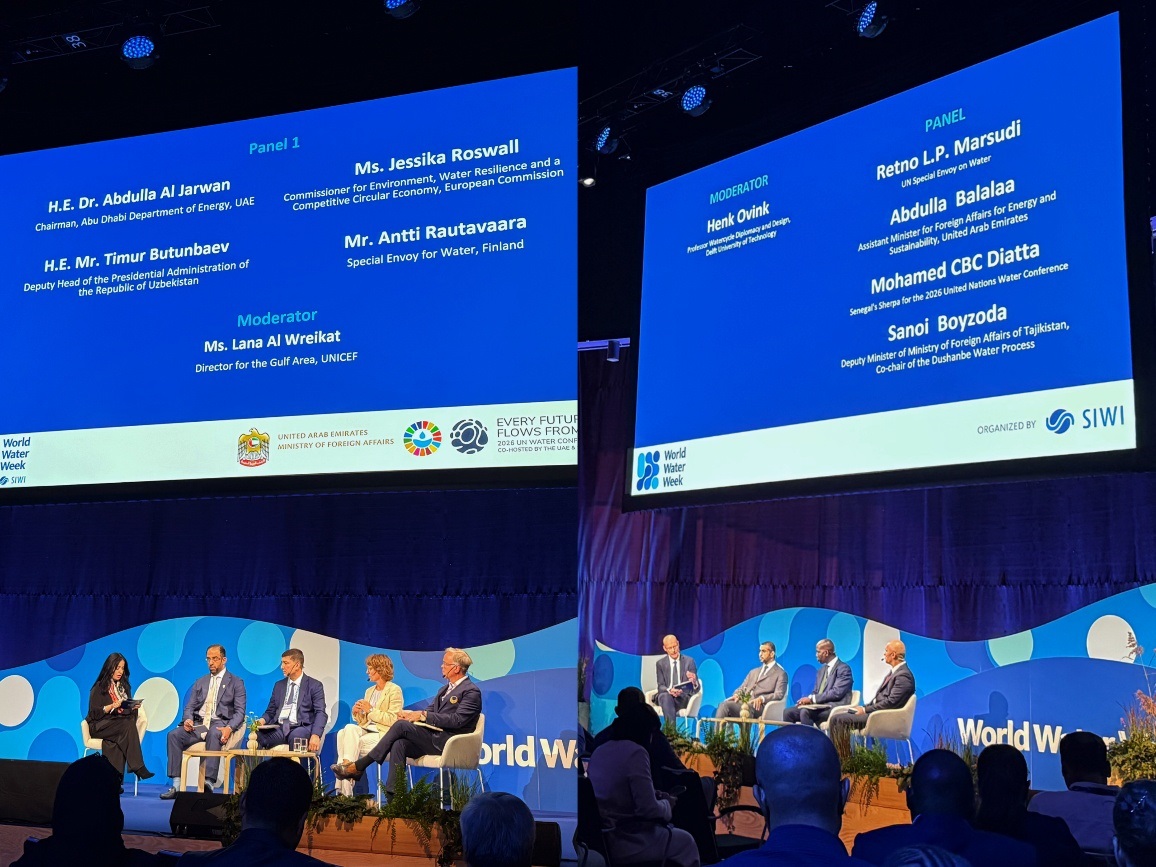
Representatives of Central Asian countries spoke at the opening ceremonies and high-level panels. Deputy Minister of Foreign Affairs of the Republic of Tajikistan S. Boyzoda noted that Tajikistan had already begun preparations for the 2028 UN Water Conference. T. Butunbaev, Deputy Head of the Presidential Administration of the Republic of Uzbekistan for Water Supply System Reform, spoke at panel discussions on the 2026 UN Water Conference and financing water sustainability. He presented Uzbekistan’s experience in transboundary water cooperation, national planning, the introduction of water-saving technologies, and financing water sustainability, noting the country’s willingness to share its experience at the 2026 UN Water Conference.
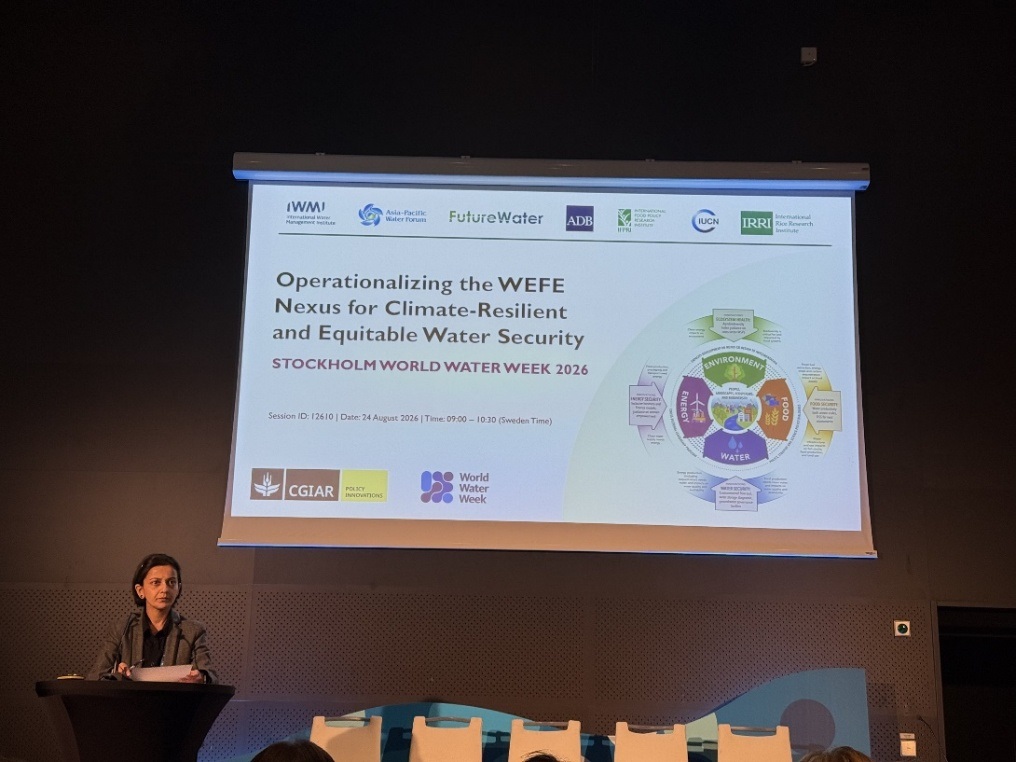
At the session “Operationalizing the WEFE Nexus for Climate-Resilient and Equitable Water Security”, participants used examples from Asian countries to discuss the transition from general commitments to practical solutions at the river basin level. Key areas included strengthening governance mechanisms, involving stakeholders in decision-making, balancing environmental needs with the demands of the water, energy and agricultural sectors, ensuring equitable water allocation, applying nature-based solutions, and using digital technologies.
Water Diplomacy amid Uncertainty
The session “Water Diplomacy in Practice: Dialogue Amid Global Uncertainty” focused on barriers to transboundary water cooperation, negotiation tools, and the organization of inclusive dialogue amid political, economic, and climate uncertainty. The session’s conclusions are intended to inform the preparation of the interactive dialogue “Water for Cooperation” at the 2026 UN Water Conference.
Data for Managing Water Supply and Sanitation Systems
A substantial part of the programme was devoted to the collection and practical use of data on water supply, sanitation, and hygiene systems. The sessions featured findings from the GLAAS 2025 report, which covers data from 105 countries and territories, as well as data from 21 development partners. The discussions underscored that sound planning requires service-level indicators to be considered alongside data on funding, the state of institutions and infrastructure, human resources, and the activities of service providers.
The Human Rights to Water and Sanitation
At the consultation session “Water for People: Advancing Human Rights to Water and Sanitation”, participants discussed measures to ensure universal and equitable access to safe water and sanitation. Particular attention was paid to the situation of women and girls, people with disabilities, rural communities, displaced persons, and populations facing climate, humanitarian, and conflict-related risks. Participants discussed how to translate general commitments into concrete, time-bound measures for the 2026 UN Water Conference.
Adapting to Increasing Water Risks
A session on building adaptive capacity presented approaches to the long-term management of flood, coastal, and urban water risks. Examples discussed included the Severn 2100 programme in the United Kingdom, planning for the protection of Singapore’s north-west coast, the work of DC Water, and the application of Decision Making under Deep Uncertainty (DMDU) in Ethiopia and Quito.
Artificial Intelligence: Opportunities and Risks
A separate discussion focused on the role of artificial intelligence in the water sector. In addition to its capabilities in data analysis, modelling, and forecasting, the discussion addressed the pressure on water resources associated with semiconductor manufacturing, power supply, and data centre cooling. Participants also addressed issues related to the quality of source data, technological dependence, equitable access to modern tools, and the equitable distribution of the benefits and costs of digital transformation.
The discussions highlighted that sustainable solutions in the water sector require the integration of data, science, financing, effective governance, and cross-sectoral cooperation.
Exhibition and Thematic Spaces
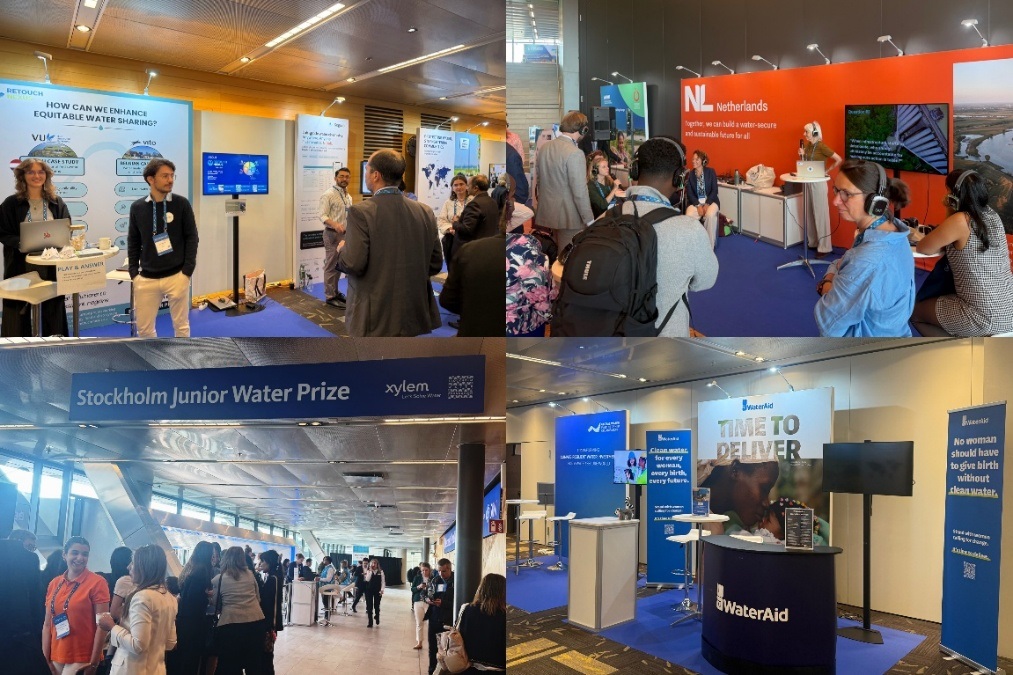
Exhibition stands and thematic spaces provided an opportunity to learn about research and practical solutions from international organizations, research institutions, and technology developers in the fields of water security, equitable water allocation, climate-resilient governance, water supply, sanitation and hygiene, digital monitoring, and rapid water-quality assessment. In particular, the presentations featured contributions from the International Water Management Institute (IWMI), WaterAid, the Global Water Partnership, representatives from the Netherlands and Mexico, as well as the RETOUCH NEXUS research project.
Youth Participation
A dedicated Stockholm Junior Water Prize area showcased projects by young researchers and inventors. These included FloodSense, developed by a participant from Kazakhstan. The project is an autonomous flood early-warning system that analyses data from ground-based sensors and NASA satellites and sends real-time alerts via a Telegram bot.
The materials presented at World Water Week are of practical relevance to SIC ICWC’s analytical and research work in the areas of the nexus approach, water diplomacy, information support, legal aspects of access to water, and strengthening the climate resilience of water management systems.
For reference: the official World Water Week website