
No. 109 (770) October 2026
SIC ICWC Presents Research Findings on Climate Resilience of Water Infrastructure in the Syr Darya Basin
On 15 October 2026, SIC ICWC took part in the 6th International Online Conference “2026 Silk Road of Knowledge” organized by the Kazakh-German University as part of the Green Central Asia initiative. The conference themed “From Dialogue to Action: Partnerships and Investments for Climate Resilience in Central Asia” focused on translating scientific findings into practice, strengthening regional cooperation, and developing joint initiatives on climate and water security.
The conference agenda addressed turning regional commitments into collective action. These challenges framed the High-Level Dialogue "From Regional Commitments to Collective Action, " which was followed by four thematic sessions: “Strengthening Regional Cooperation Mechanisms for Climate and Water Security,” “Unlocking Climate Finance for Regional Cooperation,” “Building Multi-Stakeholder Partnerships for Climate Action,” and “From Ideas to Scalable Regional Solutions.” Together, these sessions addressed cross-border coordination, climate finance mobilization, partnerships, and the wider adoption of promising climate solutions. The closing plenary “From Dialogue to Action” was designed to consolidate the discussions and identify next steps.
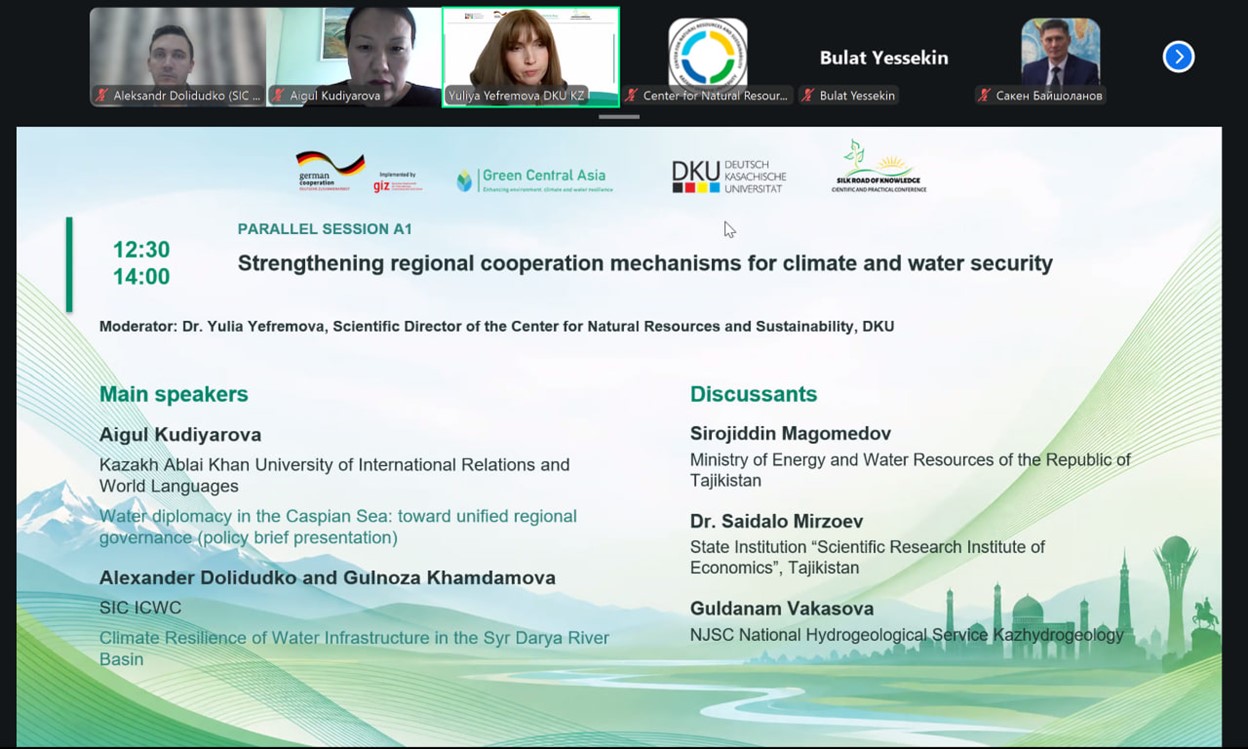
During Session A1 “Strengthening Regional Cooperation Mechanisms for Climate and Water Security,” Alexander Dolidudko delivered a presentation “Climate Resilience of Water Infrastructure in the Syr Darya River Basin.” The study was conducted with GIZ support by regional and national experts from Kazakhstan, Kyrgyzstan, Tajikistan, and Uzbekistan, under the coordination of SIC ICWC.
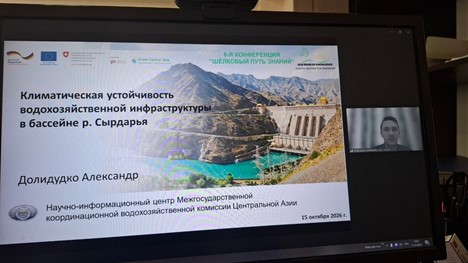
The presentation outlined the study’s findings on the climate resilience of water infrastructure across the Syr Darya Basin, covering major climate risks, the vulnerability of hydraulic structures, and priority adaptation measures. Particular emphasis was placed on comprehensive infrastructure modernization, improved monitoring and forecasting, and coordinated operation of interconnected facilities. The presentation highlighted the importance of regional cooperation and data exchange in ensuring reliable water supply and safe infrastructure operations under changing climatic conditions.
During the discussion, Alexander Dolidudko responded to three questions concerning how the study’s findings could support stronger regional cooperation, improved monitoring, forecasting and data exchange, and the development of joint adaptation measures. His responses emphasized coordinated climate risk assessments, enhanced coordination of water infrastructure operation, and joint projects to strengthen infrastructure resilience across the Syr Darya Basin.
Questions addressed to other speakers explored priorities for regional water cooperation, the economic benefits of joint water management, and mechanisms for attracting investment in climate-resilient infrastructure. The discussion also touched on lessons from UNDP projects in the Kyrgyz Republic, opportunities for joint early warning systems and basin planning, institutional cooperation in the Caspian region, and joint environmental monitoring and transboundary impact assessment.