
No. 114 (775) October 2026
SIC ICWC Presented its Experience in Scientific Support of Water and Ecosystem Management in Central Asia
On 21–23 October 2026, the Academy of Sciences of the Republic of Uzbekistan hosted the international conference “System Analysis for Assessing Natural Disaster Risks and Adapting to Climate Change” in Tashkent. The conference agenda covered scientific methods for assessing natural hazards, modeling environmental changes, restoring degraded ecosystems, and adapting the agricultural sector to climate change. Particular attention was paid to the Aral Sea and the Aral Sea region, as well as to the application of remote sensing, geographic information systems (GIS), and artificial intelligence.
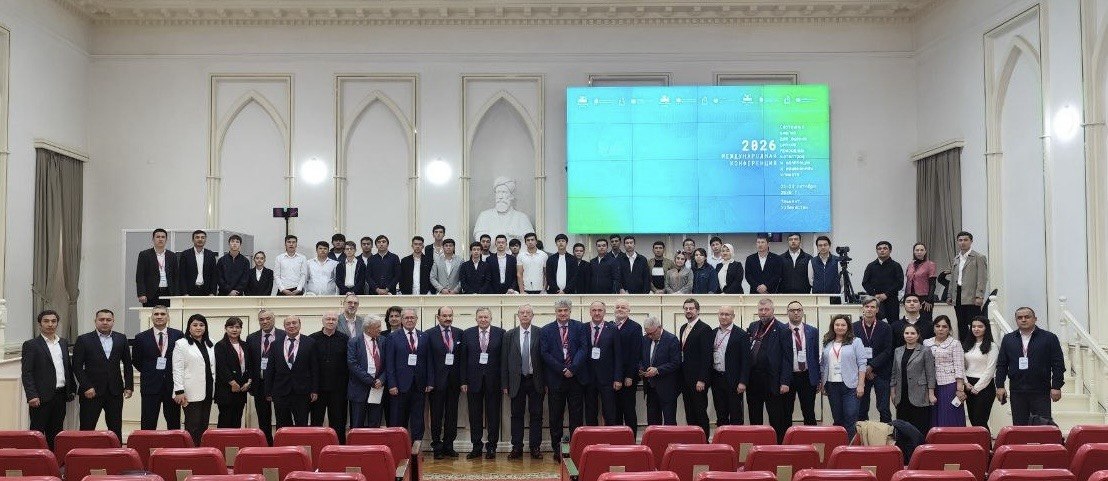
On 22 October, D. Ziganshina, Director of SIC ICWC, delivered a presentation “Scientific Support for the Sustainable Management of Water Resources and Ecosystems in Central Asia.” The presentation was part of the applied session “Modeling Environmental Changes and Developing Measures to Stabilize Degrading Ecosystems.”
She outlined the SIC ICWC’s long-standing experience in integrating scientific research with interstate dialogue and water management practices. Dr. Ziganshina highlighted the role of the ICWC in coordinating transboundary water use and the Center’s work in preparing data, analytical materials, and tools to support joint decision-making.
A significant part of the presentation focused on the findings of two studies conducted by the SIC ICWC as part of the GIZ-supported basin dialogues on the Amu Darya and Syr Darya. The study on the Amu Darya focuses on ecosystem conservation, from runoff generation areas to floodplain and delta systems. National and consolidated reports, field survey results, and a GIS map of protected natural areas were presented. The priority areas identified included ensuring environmental flows, restoring tugai forests, maintaining ecological corridors, and developing coordinated monitoring.
A study on the Syr Darya examines the climate resilience of water infrastructure. Based on an analysis of 32 key facilities, the study highlights the need to combine infrastructure modernization with improvements to operational procedures, the development of hydrometeorological observation networks, and transboundary coordination. It emphasizes that engineering adaptation measures must take into account the basin’s ecological needs and be complemented by nature-based solutions.
Special focus was given to the information infrastructure supporting cooperation: ten-day monitoring of water balances of the Amu Darya and Syr Darya, the CAWater-Info portal, the CAWater-IS regional information system, and the use of GIS and models to assess vulnerable areas and identify targeted measures, implemented with the support of the IKI Nexus project.
The key takeaway from the presentation is that the resilience of Central Asia’s water and ecosystems depends on maintaining a continuous link between reliable data, scientific analysis, coordination of national interests, and the implementation of measures on the ground. The SIC ICWC’s accumulated experience demonstrates the importance of continuous scientific and information support for regional cooperation in the context of climate change.
On the second day of the conference, V. Sokolov presented “A Brief History of the Aral Sea and the Status of Its Remaining Water Bodies Based on Available RS-Data” co-authored by L. Sychugova and I. Ruziev.
The presentation demonstrates the results of long-term research and monitoring based on Landsat satellite imagery, covering changes in the Western and Eastern Aral Seas, the North Aral Sea, and the lake systems of the Amu Darya Delta. It examines fluctuations in inflows to the Northern and Southern Aral regions, available water in these bodies, and the volumes of water required to maintain their stable condition.
The key findings indicate that the status of the remaining water bodies in the Aral Sea region remains extremely unstable. According to SIC ICWC data, between May 2011 and September 2026, the water level in the Western Aral Sea fell by 9.77 m, while its surface area decreased by approximately half. Over the past 8.5 years, the average annual inflow to the North Aral Sea was 1.49 km³, equivalent to about 43% of the required volume. In the Southern Aral region, the average inflow over the same period met approximately 55% of the estimated water requirements of the delta lakes.
The presentation highlighted the need for systematic satellite and ground-based monitoring, improved water supply management, and the implementation of evidence-based measures to preserve the remaining water bodies and ecosystems in the Aral Sea region.
Learn more about the IKI Nexus