
No. 116 (777) October 2026
SIC ICWC Presented Approaches to Assessing Water and Climate Risks
On 27 October 2026, an International scientific-practical workshop “The Impact of Water and Climate Risks on Uzbekistan’s Economy and Opportunities for Green Development” was held in Tashkent. The event was organized by the Institute for Macroeconomic and Regional Studies (IMRS) under the Cabinet of Ministers of the Republic of Uzbekistan.
The workshop focused on the economic impacts of climate change on Uzbekistan, the risks associated with water scarcity, and opportunities for adapting to changing climatic conditions. Experts from the National Research University “Higher School of Economics” (HSE, Russia) presented the atlas “The Impact of Changes in Water and Climatic Conditions on the Economic Development of Uzbekistan.”
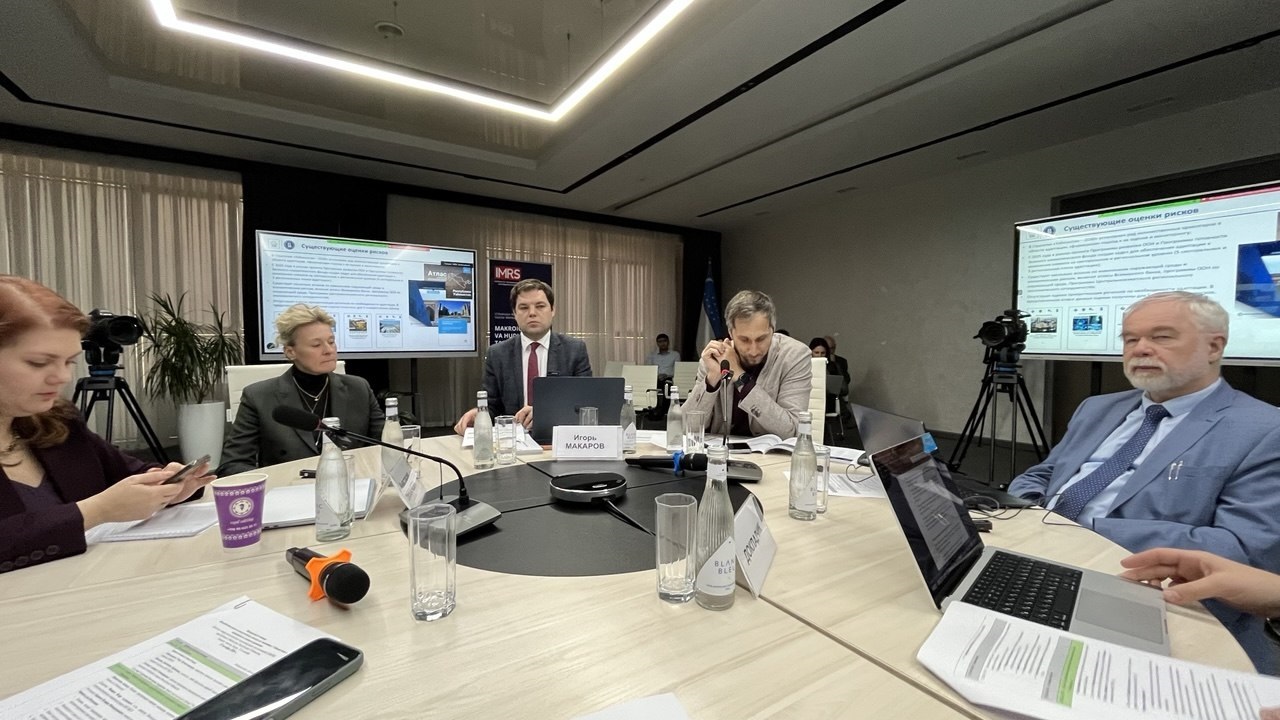
Dinara Ziganshina, Director of SIC ICWC, presented the results of regional studies on water and climate risk assessment and the resilience of water infrastructure. In particular, she spoke on the assessment of climate resilience of water management infrastructure in the Syr Darya basin, conducted to inform basin dialogue within the framework of the GIZ “Green Central Asia” Initiative. The research findings are intended to help the basin countries identify vulnerable elements of their water management systems and prioritize measures for adaptation.
Dr. Ziganshina also presented water security indicators developed by SIC ICWC as part of a project of the International Climate Initiative (IKI). These indicators provide a comprehensive assessment of the water management situation and make it possible to monitor changes in water security levels over time. In her presentation, D. Ziganshina emphasized the importance of taking transboundary factors into account when assessing water and climate risks to Uzbekistan’s economy. Climate change, evolving water use in the basin countries, and the condition of shared water infrastructure require coordinated approaches to risk assessment, forecasting, and management.
Workshop participants also discussed how research findings can be used to identify adaptation priorities, guide investment in water infrastructure, and inform the development of Uzbekistan’s water security policy.