
No. 118 (779) November 2026
SIC ICWC Presents Digital Tools for Regional Cooperation and Research Findings on Climate Resilience of Water Infrastructure at the 29th Session of the SPECA Working Group
On November 2, 2026, the 29th session of the Working Group on Water, Energy and Environment of the United Nations Special Programme for the Economies of Central Asia (SPECA) was held in Bishkek. The meeting was jointly organized by the United Nations Economic and Social Commission for Asia and the Pacific (ESCAP) and the United Nations Economic Commission for Europe (UNECE).
The SPECA Working Group serves as a regional platform for addressing shared challenges in water resources, energy, and environmental protection, exchanging experience, and developing practical approaches to strengthening cooperation among Central Asian countries. Its work promotes coordinated management of interconnected resources, sustainable development, and joint regional initiatives.
The 29th session focused on practical solutions to align sectoral priorities, strengthen climate resilience, and enhance regional cooperation. Particular attention was paid to the nexus approach, which considers the interconnections among water, energy, land use, agriculture, and ecosystems.
The agenda covered several interconnected areas: applying the nexus approach to natural resource management, advancing nature-based solutions, ensuring the safety of dams and other water infrastructure, and exploring opportunities for sustainable small hydropower development. Participants discussed climate risks, cross-sectoral planning, improvements to legal and institutional frameworks, capacity building, and stronger regional cooperation. The meeting concluded with a discussion of the Working Group's priorities for 2027.
SIC ICWC presented its digital tools and research findings in two thematic sessions addressing cross-sectoral cooperation and the climate resilience of water infrastructure.
During the first thematic session devoted to the water–energy–land–ecosystems nexus Aurika Galustyan delivered an online presentation “Nexus Navigator: Digital Tools for Strengthening Water–Energy–Food–Ecosystems Nexus and Regional Cooperation in Central Asia.”
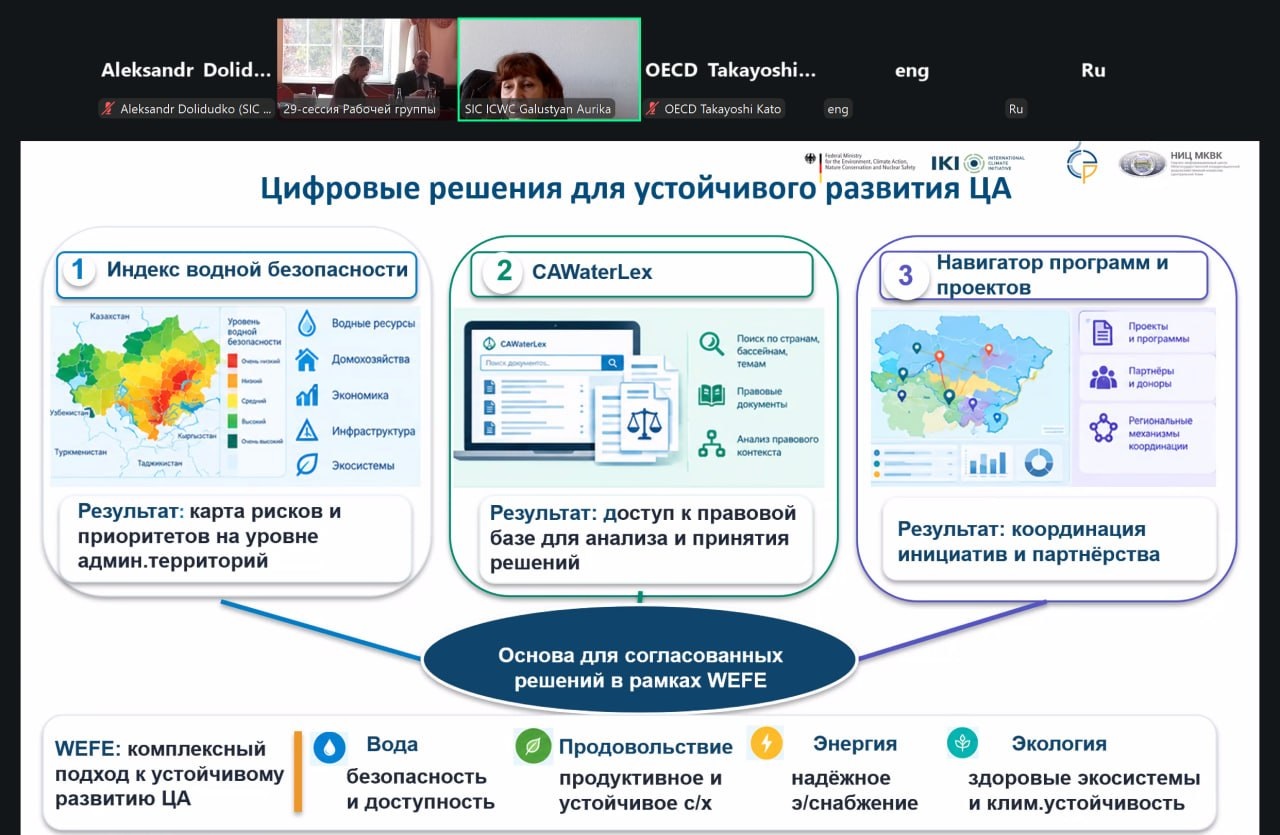
The presentation highlighted practical results of SIC ICWC's work under the IKI project “Regional Mechanisms for a Low-Carbon, Climate-Resilient Transformation of the Energy–Water–Land Nexus in Central Asia.” Four digital tools designed to provide information and analytical support for sustainable regional development were presented:
- Water Security Index for Administrative Territories — a tool for identifying local risks, mapping vulnerable areas, and informing priority measures and investments.
- CAWaterLex — a legal information system providing access to national and international documents on water, energy, agriculture, land use, and environmental protection.
- Navigator of International Cooperation in Central Asia — a tool under development to systematize information on programs, projects, partners, and mechanisms for regional cooperation.
- Nexus Navigator of Sectoral Strategies — a tool under development to assess the alignment of national and sectoral strategies, taking into account the water, energy, agriculture, land use, ecosystems, and climate nexus.
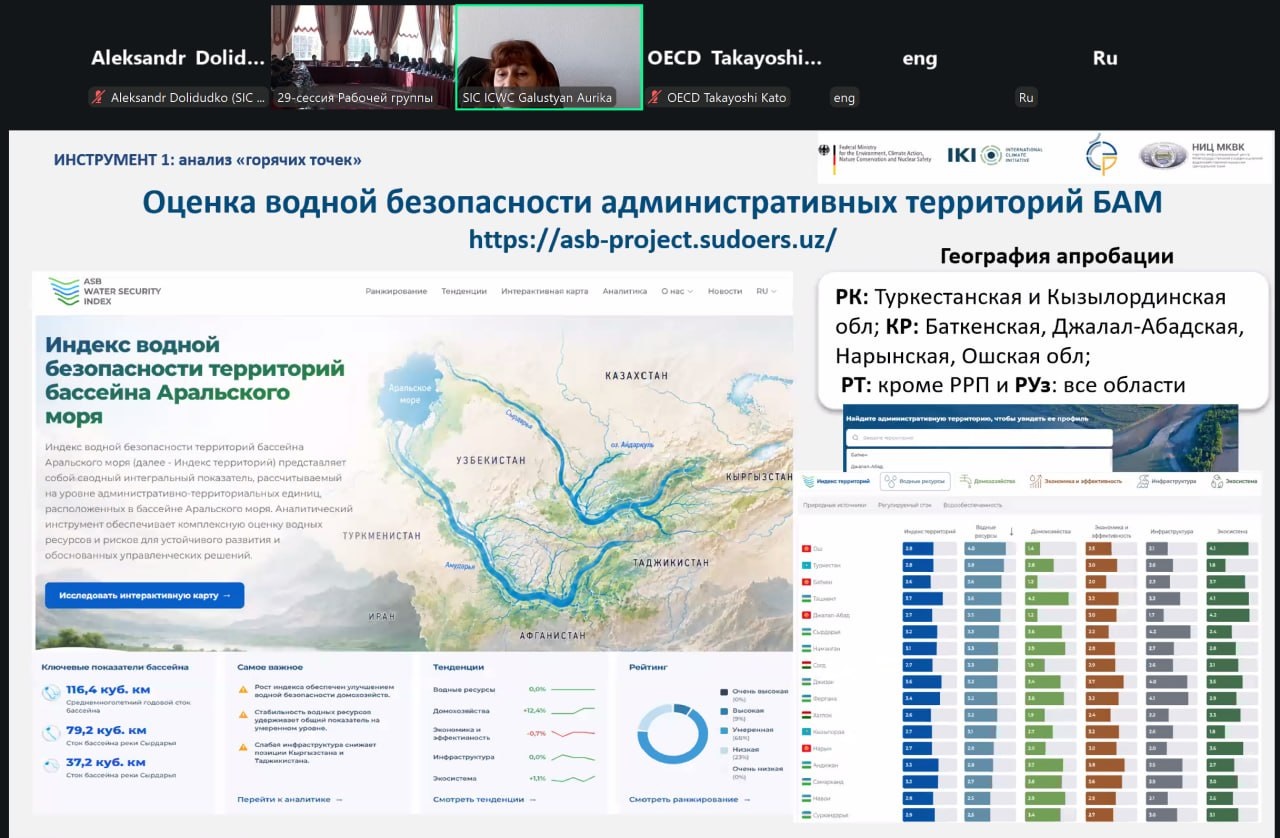
These tools complement one another by helping identify areas facing the most pressing water security challenges, access relevant legal information, analyze international cooperation initiatives, and assess how well strategic documents address cross-sectoral interdependencies. Together, they provide an information base for more coordinated planning and informed decision-making.
During the third thematic session, dedicated to dam safety and hydraulic structures, Alexandr Dolidudko delivered a presentation “Climate Resilience of Water Infrastructure in the Syr Darya River Basin.”
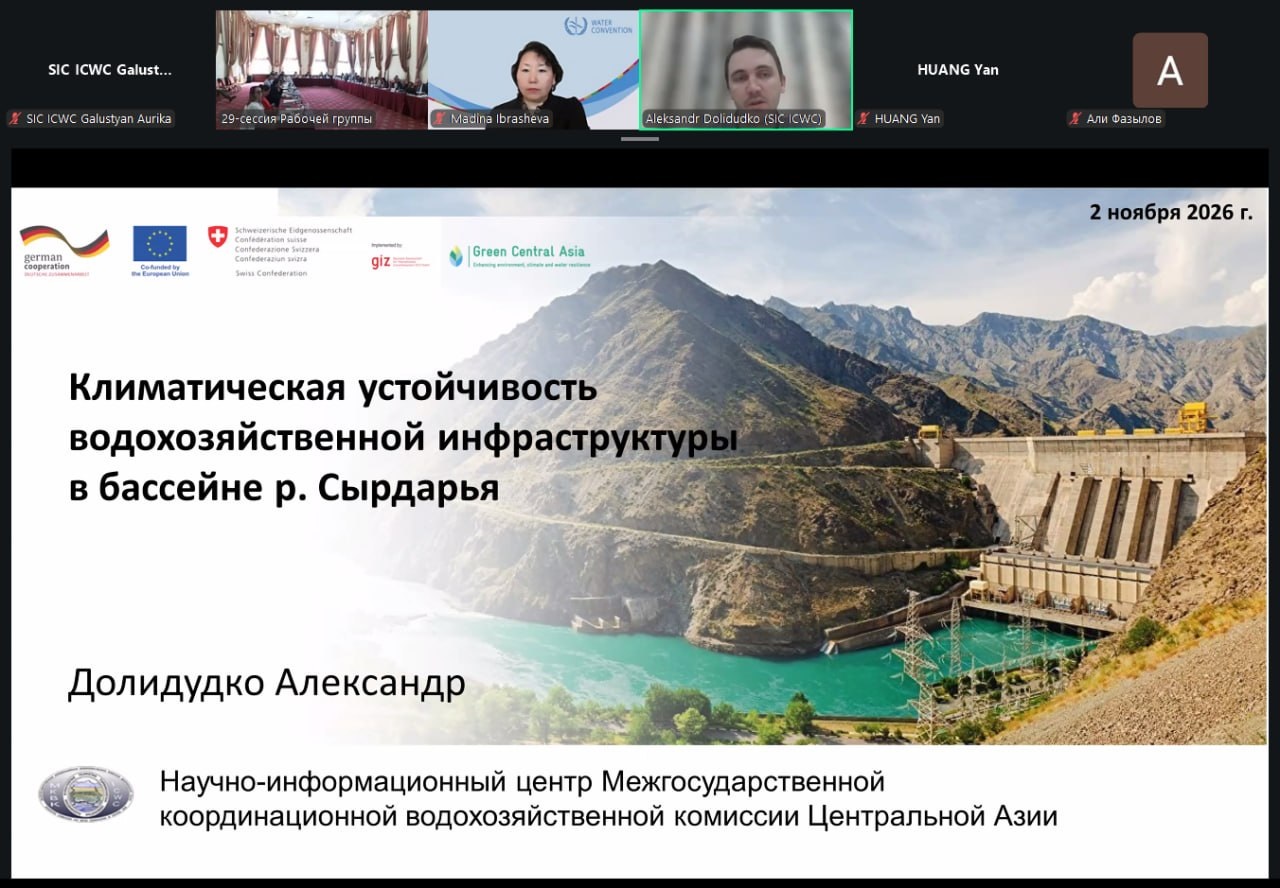
The presentation addressed one of the meeting's key themes: improving the safety and reliability of water infrastructure under changing climatic conditions. The resilience of hydraulic structures is particularly important for Central Asia, where water infrastructure plays a vital role in water supply, irrigation, and other water uses.
SIC ICWC's presentation contributed to discussions on the regional status of dam safety, national legal and institutional frameworks, capacity building, and stronger cooperation among countries. The assessment of climate resilience in the Syr Darya Basin highlighted the need to account for climate risks when evaluating infrastructure condition and planning measures to improve reliability.
SIC ICWC's participation in the two thematic sessions demonstrated the complementary nature of the Center's work. Its digital tools provide information and analytical support for aligning cross-sectoral priorities, while its infrastructure research helps improve understanding of climate risks and the resilience of water infrastructure.
Overall, discussions at the 29th session of the SPECA Working Group reaffirmed the importance of an integrated approach to managing interconnected resources and strengthening regional cooperation. Addressing shared challenges requires Central Asian countries to combine coordinated policy approaches with practical tools, reliable information, and scientific evidence-based solutions.
SIC ICWC continues to contribute to these efforts by developing digital tools and analytical approaches that support sustainable water management, greater climate resilience, and stronger cooperation across Central Asia.