
No. 120 (644) November 2025
OSCE Committee Discusses the Climate–Water Nexus with Experts from Central Asia
On 21 November, the Economic and Environmental Committee of the Permanent Council of the Organization for Security and Co-operation in Europe (OSCE) held a thematic meeting on exploring the complementarities and added value of the OSCE’s work on the critical climate–water nexus across its region.
Chaired by Ambassador Melita Župevc, the meeting featured keynote presentations and expert contributions highlighting the interlinkages between climate change, water scarcity and security.
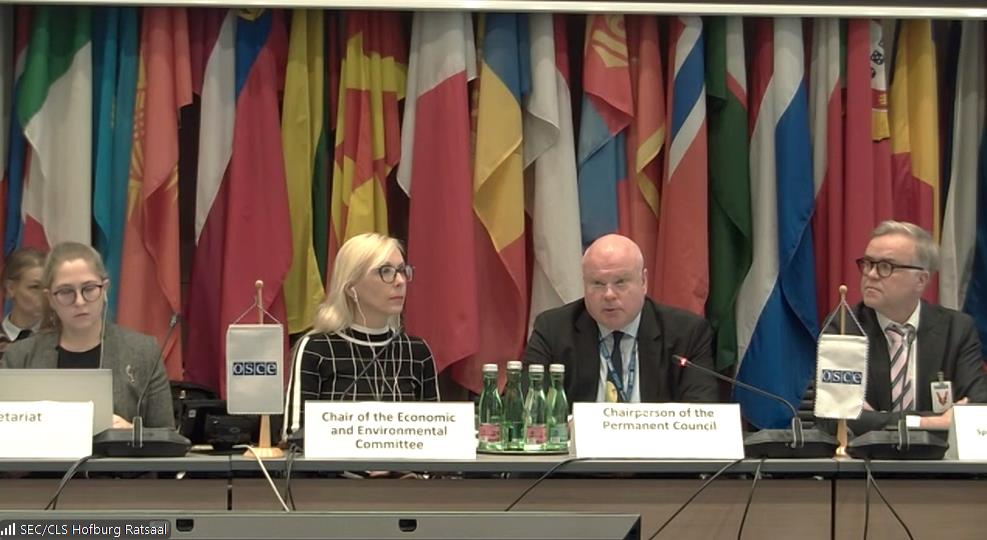
The discussion, Exploring the Complementarities and Added Value of the OSCE on the Climate–Water Nexus, featured presentations by Mr. Antti Rautavaara, Special Envoy for Water at the Ministry for Foreign Affairs of Finland; the SIC ICWC Director; and representatives from the Geneva Water Hub and the UNECE Water Convention Secretariat.

Mr. Rautavaara emphasized the importance of the Water Convention in the context of climate change and increasing pressure on water resources. He called for continued support for countries in the process of acceding to the Convention.

In her presentation, Dinara Ziganshina, Director of SIC ICWC, highlighted the existing OSCE framework in Central Asia, including work on environmental security assessments in the Amu Darya basin and support for inclusive diplomacy through initiatives such as the Women in Water Diplomacy Network and Drops of the Future. She also outlined SIC ICWC’s work on the climate–water nexus, including the EU–UNEP project on climate, environment, peace and security in the Fergana Valley; the development of regional mechanisms for nexus cooperation; support for the Expert Platform on Water Security and Sustainable Development with a focus on nexus, women and youth; joint research on the Water Heritage in Central Asia; and ecosystem assessments in the Amu Darya basin as part of the GIZ regional programme Green Central Asia and its project Climate-sensitive water resources management in Central Asia.
She proposed three areas where the OSCE could offer particular added value: developing new digital tools to support data sharing; continuing to support women’s and youth networks; and promoting pragmatic, step-by-step engagement with Afghanistan.
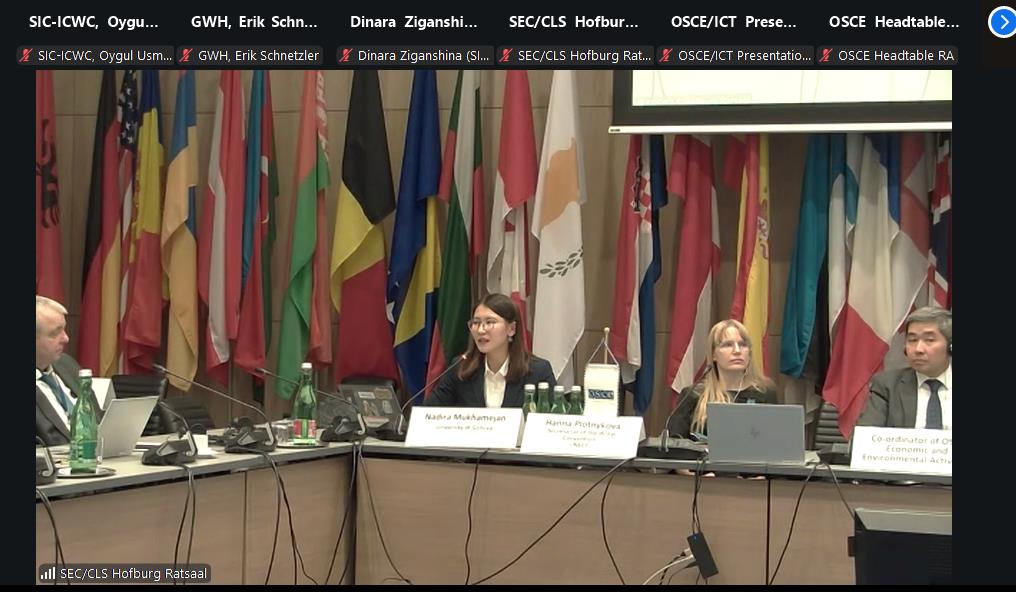
Representatives of the Geneva Water Hub presented their current work, focusing in particular on the recently completed online course on data exchange and digitalization in the water sector, developed in collaboration with the OSCE. The course introduces current technologies for data collection and exchange, as well as institutional mechanisms that enable effective information sharing. It aims to promote cross-learning through case studies from various countries and regions. Speakers emphasized that a lot of data is available but these need to be translated and feed into political processes.

Hanna Plotnykova, representing the Secretariat of the Water Convention (UNECE), presented the joint OSCE–UNECE project on the climate–water nexus in the Dniester basin. Under this partnership, a climate adaptation strategy is being developed and specific adaptation measures are being prepared.