No. 136 (660) December 2025
From Adaptive Participant to Co-Author of the Global Agenda: Uzbekistan’s Diplomatic Initiatives at the UN General Assembly (2020–2025)
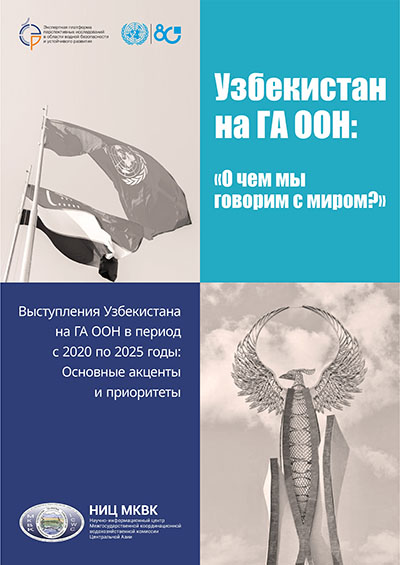
ПOn the occasion of the 80th United Nations anniversary, SIC ICWC has released a new study examining the evolution of Uzbekistan’s foreign policy through country speeches at the UN General Assembly. The study covers the period from 2020 to 2025 and builds upon earlier research in 2021, where SIC ICWC analyzed statements of Uzbekistan at the UN General Assembly from 1992 to 2020. Focusing on the most dynamic five-year period, the analysis highlights a phase in which Uzbekistan’s diplomacy expanded to a fundamentally new scale. In this period, the country demonstrated a qualitative leap forward in global governance system.
Key findings of the study:
The analysis demonstrates that over the past five years Uzbekistan’s foreign policy has undergone a transformation across three key dimensions:
- From rhetoric to strategy: There has been a shift from declarative statements to a systematic and conceptually structured approach. Each speech is clearly aligned with the 2030 Agenda for Sustainable Development and includes concrete institutional solutions.
- Identity and initiative: Uzbekistan has moved beyond the role of a passive participant in international processes. Today, the country plays an increasingly active role in shaping the global agenda through initiatives in climate policy, digitalization, youth rights protection, and poverty reduction.
- A new model of regional leadership: In Uzbekistan’s statements, Central Asia is framed as a region of opportunity rather than one of challenges. Particular attention is given to:
- Environmental security and addressing the consequences of the Aral Sea crisis;
- Rational management of transboundary water;
- Peacebuilding in Afghanistan.
“Uzbekistan’s statements at the UN General Assembly between 2020 and 2025 signal the emergence of a new national narrative, portraying the country as a modern, inclusive, and responsible actor capable of contributing solutions at both regional and global levels,” the study notes.
Conclusions and prospects
The findings of the study provide a comprehensive overview of the evolution of Uzbekistan’s foreign policy priorities. The analysis is intended to serve as an important tool for diplomats, international experts, and policy analysts seeking to assess and shape the future trajectory of Uzbekistan’s foreign policy in a changing world order.
The development of a unified analytical database covering the entire Central Asian region will enable:
- Comparative analysis of the foreign policy priorities of Central Asian states;
- Identification of converging priorities and shared areas of cooperation in ecology, water, and regional security.
- Formation of a comprehensive understanding of Central Asia’s collective voice and positioning in global diplomacy.
The full publication is available here